MicroLink.Brief · The Bridge
Download PDF

01 · The Ask

Capacity. Customer. Growth.

This round raises $25 million of company capital into MicroLink USA. It builds the two New York pilots with NYSERDA, stands up the team and the integration workshop that becomes the R&D center, signs the revenue contract, and carries the company to a priced project round.

Confidential · July 2026 · A $25M company round
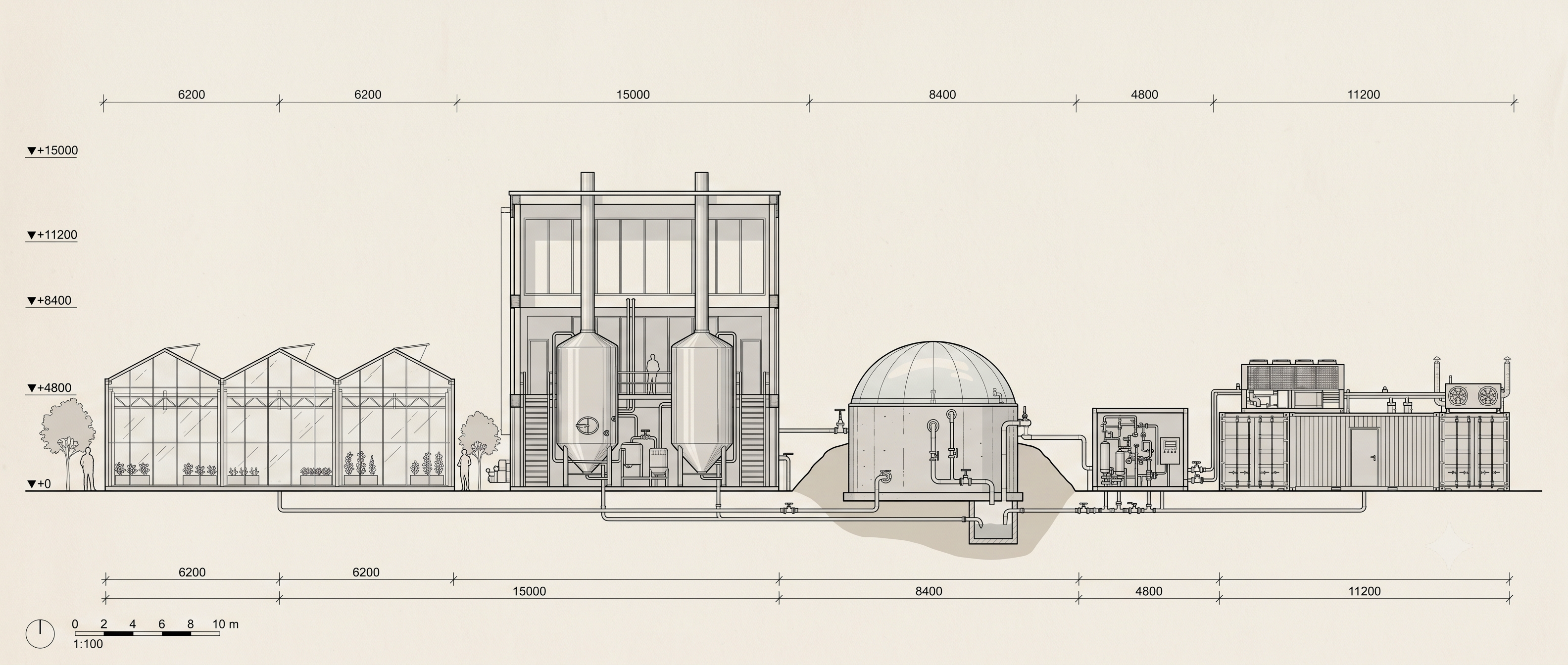
Elevation drawing at 1 to 100 of a host integration, showing a greenhouse range, a brewery, a digester and a containerised compute hall with dry coolers, connected by a below ground pipe run, with dimensions and a scale bar

The binding constraint in the current market is not land or capital but the speed at which power reaches the rack. Grid interconnection for a transmission-level load runs three to six years, while on-site generation and host integration energizes a campus on equipment and permit time. That gap is the company's wedge.

$25M
company capital
$5.71B
programme behind it
1.55 MW
pod and edge sites
02 · The Edge · where the value compounds

MicroLink's DDCaaS in the world's most dynamic market.

Value beyond the rack

MicroLink deploys compute where it creates value beyond the rack. Recovered heat is delivered to host partners as usable warm water for district heating, process loads, or controlled-environment agriculture. On-site generation energizes a campus on equipment and permit time rather than interconnection queues.

How we know it is working

The clearest evidence is that other people are carrying the model. Partners and counterparties share it unprompted and bring MicroLink projects that stalled or failed elsewhere, asking whether this approach can win the buy-in they could not. NVIDIA recommended MicroLink to NYSERDA, and that referral has since opened a second workstream with a different department inside the agency. The company is building from a position where the market is already selling the model on its behalf.

Primer · heat recovery and the thermal architecture

Each site runs a three-loop thermal architecture. Direct-to-chip cold plates carry heat off the silicon into a closed technology loop, a facility loop transfers it to the heat-rejection plant, and a recovery loop delivers usable warm water to the host partner. Heat rejection is dry-cooler-first, with an always-available dry-cooler backstop sized to carry the full load independently, so compute availability never depends on the heat offtake being taken.

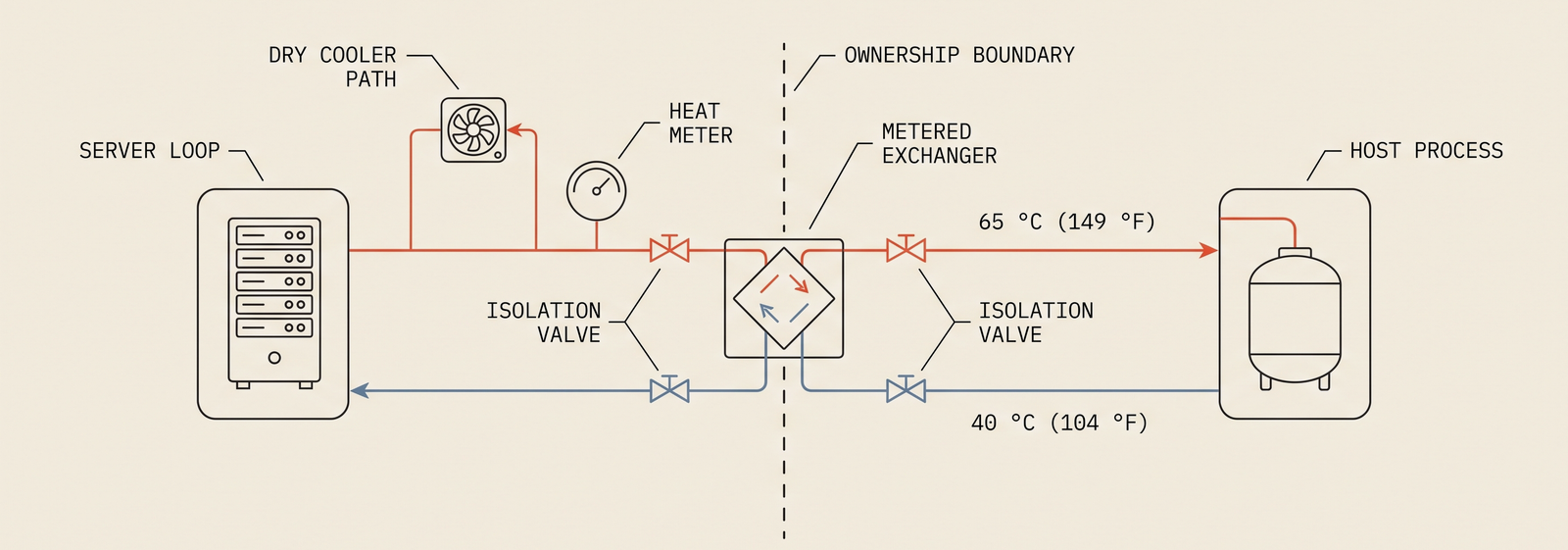
Recovered heat is delivered at roughly 65 degrees Celsius [149 Fahrenheit] and returns at 40 degrees Celsius [104 Fahrenheit], delivered into district-heating networks, process loads, or controlled-environment agriculture. Design PUE is approximately 1.10 to 1.15, with ERE below 1.0 where heat is taken. Recovered heat is a value-add to the host partner, never a driver of the financing.

03 · Use of Proceeds · where the $25 million goes

Where the $25 million goes.

MicroLink has line of sight on seven campus sites, five Pods, and fifteen Edge sites. All are at different stages of development and none should be considered final: this space moves fast, and the company needs to be nimble enough to shift as opportunities come up. The shape of the portfolio is designed around the ability to build, commission, and operate these sites. Once a site reaches a defined stage of development it is communicated to the customer pool.

$25.0M COMPANY CAPITAL LINESHARE$M Pod sites54%13.5 Edge sites4%1.0 R&D center12%3.0 Staffing9%2.1 Runway, G&A and contingency12%3.0 Pipeline and site development4%1.1 Commercial and legal restructure4%1.0 Customer acquisition and offtake1%0.3

This round builds the capacity for that process to scale, de-risks sites faster, and shifts the company to closing the customer. The proof starts with the pilots: the offtake that makes the programme financeable cannot be won without them underway, and the New York pilots with NYSERDA are the first through the process, funded directly by this round.

Table 01 · use of proceeds
$25M company capital
LineShare$MPurpose
Pod sites54%13.5One 1.25 MW liquid cooled pod, long lead deposits drawn early.
Edge sites4%1.0Ten 30 kW edge units in K to 12 schools and other New York City government infrastructure.
R&D center12%3.0Reference pod and Edge hardware, the 800 V DC power layer, and controls integration.
Staffing9%2.1Eight people, two years, fully loaded.
Runway, G&A and contingency12%3.0Corporate burn to the priced round and build contingency.
Pipeline and site development4%1.1Interconnection studies, due diligence, permitting, and legal on named sites.
Commercial and legal restructure4%1.0Entity structuring and round legal.
Customer acquisition and offtake1%0.3Proposal engineering and offtake negotiation, converting the live build into a signed customer.
Total100%25.0

Allocations are indicative and planning-grade, to be fixed at term sheet.

04 · The Pilots · the New York showcase

Flagship pilotsTwo NYSERDA pilots, two departments

NVIDIA recommended MicroLink to NYSERDA, and that referral has since opened two separate workstreams inside the agency. The schools department pilot places 30 kW edge units into K to 12 schools and other New York City government infrastructure. The innovation center pilot builds an integration workshop and deploys the 1.25 MW pod, with the workshop transitioning into MicroLink's R&D center as the pilot completes. Together they run the full product range with a single programme partner, and this round funds both directly.

nyserda.ny.gov ↗
Table 02 · pilot phases
PhaseStatusScope
Phase one · LiveIdentify and planningReview of eight heat recovery sites (State schools, waste to energy, hydro, brewery, WWTP).
Phase two · PilotSites go liveTen 30 kW edge units and one 1.25 MW pod.
Phase three · ScalingProject rolloutShared capital deployment, multiple sites, under the current 20 MW moratorium.

The reference pod

The pod is 1.25 MW, liquid-cooled, with an 800 V DC power layer that sits on the roadmap of Vertiv, NVIDIA and Heron. The company-funded scope is the thermal plant, the containers, the host interface, the controls, and the dry-cooler rejection path, with the dry-cooler backstop sized to carry the full load independently so availability never depends on the heat being taken. Silicon is financed at asset level against the tenant contract.

The customer logic

MicroLink is working to secure an offtaker for the NYSERDA pilots. That signature does not come against a deck: it comes against a live build the customer can measure. The round exists to start the build that wins the customer, and the signed offtake then finances every site after it at project level.

05 · The Programme · the first wave behind the round

The first wave of the build.

Behind the company round sits the first wave of the build: more than 378 MW of critical IT load across five core sites, at a facility funding requirement of approximately $5.71 billion. That capital is raised at project level, each site in a bankruptcy-remote special purpose vehicle that owns the asset and holds a 20-year triple-net lease, financed by a fully-amortising senior secured bond matched to the lease and retired by contracted rent. None of it touches the $25 million raised here.

Table 03 · core programme, five sites
SiteLocationMW ITTier
2028 CampusOhio / N Arizona / N Pennsylvania / Massena NY+250Owned
PhiladelphiaGrays Ferry, PA45Host
New YorkNew York, NY60Host
Bay AreaSan Jose, CA15Host
BethlehemNorthampton Co, PA8Owned
Total, five sites+378

CommunityHow MicroLink shows up in a town

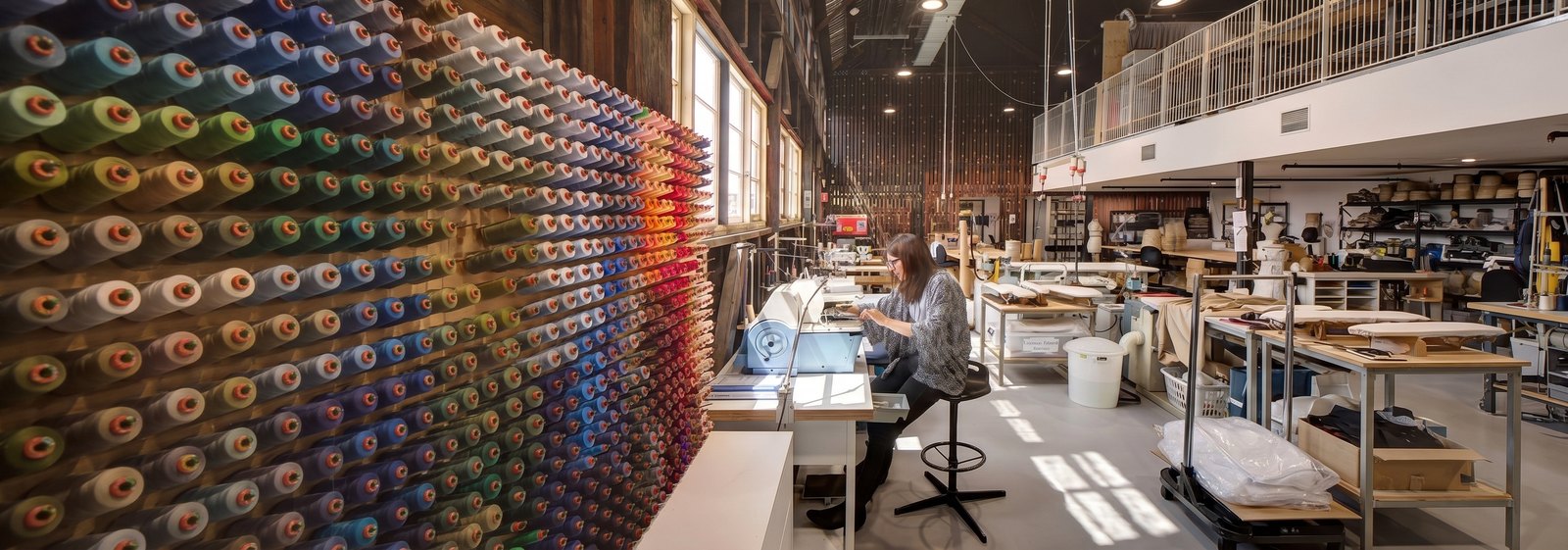
A workshop interior with a wall of coloured thread spools and a maker at a bench

Every deployment is designed as community infrastructure: commitments written down, independently advised, and publicly reported each year. Mansfield, Ohio is where that is being worked through in public.

Mansfield Community Site

TechnologyOne stack at three scales

A schematic of the metered heat delivery interface, showing the server loop with its dry cooler path and heat meter, the metered exchanger at the ownership boundary with isolation valves either side, and delivery to the host process at 65 degrees Celsius with return at 40 degrees Celsius

MicroLink standardises hardware with Vertiv and develops the layer above it: control software, system design, 800 V DC, and the coupling of generation and heat recovery to compute. Three filings, patent pending.

Technical Developments
06 · Management · the team

Management team & structure

Experienced, nimble, grounded and driven

The MicroLink team is grounded in being insiders in the data center industry. From designing, building, and deploying data centers across multiple countries and environments, our experience runs deep in both property and energy, and across financial, legal, and technical expertise. With a focus on both public and private enterprise, decades of relationships with key partners, and a comprehensive understanding of not only what is now but what is next, in an industry still working that out itself.

Nick Searra
CEO, Co-Founder

Two decades of data centre and power infrastructure development across Africa, the Middle East, and Europe, building EMEA revenue for Eltek and Enatel power systems, Bladon micro turbines, and Master Power Technologies. Deep operator networks across utilities, municipalities, and hyperscale supply chains. Leads strategy, capital formation, and offtake, and architects the company's digital platform.

LinkedIn ↗
Sancha Olivier
CEO, Co-Founder

Data centre architect and senior project manager who has run every stage of the development cycle, from site identification through design, construction, commissioning, and operation. The core of the team and the standard for how MicroLink shows up in the world, with insight matched only by her work ethic.

LinkedIn ↗
Shane Pather
CTO

Controls and instrumentation engineer who commissioned some of Europe's largest heat-recovery data centres in Finland and Denmark. Owns the thermal loop control architecture, the site commissioning programme, and the controls stack that makes recovered heat bankable.

LinkedIn ↗
Dane Harvey
CFO

Thirteen years with GE, ending in Boston HQ as Global Cash FP&A Leader, partnering across finance teams to deliver GE's cash commitments and report results to investors. Part of the core finance team executing the spin-offs of GE units into three investment-grade companies.

LinkedIn ↗
Jamie Brown
General Counsel

General counsel with over a decade in data centre and real estate development. Most recently Partner and General Counsel on Fifth Space's San Francisco $4B, 5.4M sq ft redevelopment. Prior to this, representing Meta across several developments in the US and Singapore. Harvard Law and UC Berkeley, and a member of the California Bar.

LinkedIn ↗
Carla Trippe
Head of Operations and Impact

Performance, learning, and strategy specialist with fourteen years driving measurable impact across international development, including a $457M USAID portfolio, the Gates Foundation, and the United Nations, now at Social Impact. Leads operations and the impact framework that anchors the community and ESG case with hosts and municipalities.

LinkedIn ↗
Andrew Thomas
Chief Commercial Officer

Columbus, Ohio based energy storage and sustainability executive, co-founder and president of Acculon Energy, with industrial B2B sales leadership at Crown Battery and FIAMM. Leads brand, commercial partnerships, and outreach, proximate to the Midwest target markets.

LinkedIn ↗
Jeff Svedahl
CEO, MicroLink Edge

Strategic sourcing and financial executive with twenty-five years leading global procurement for Choice Hotels, Radisson, Best Buy, and Target, and an MBA from the Carlson School. Leads the MicroLink Edge vehicle, bringing supplier strategy, contract negotiation, and cost discipline to the edge programme.

LinkedIn ↗
Heath Andersen
Data Centre Design Advisor

Over twenty-five years of data centre design across Australia, the UK, the Middle East, and Africa, now advising global investors and operators on how to plan, build, and buy data centres. Leadership at Ramboll across the UAE, Qatar, KSA, and Oman, and managing data centre design and delivery at Arup Africa. Heath allows our market analysis, feasibility, and site due diligence to be well planned and structured.

LinkedIn ↗
David Hassler
Head of Sales and Customer

Twenty-five years in global infrastructure capacity planning, including seventeen at Akamai as Global Capacity Manager across a $400M capex platform, now at Vultr. Brings the buyer's perspective on how hyperscale and cloud customers procure capacity.

LinkedIn ↗
Deniz Akgul
Capital and Investment Advisor

Structured-finance advisor with two decades at Houlihan Lokey, Brevan Howard, BlueCrest, and Gleacher Shacklock (MSc, LSE). Advises on capital structure, lender engagement, and the project finance raise.

LinkedIn ↗
07 · Milestones to the Priced Round

The path is short and each step earns the next. Close the company round and stand up the US subsidiary and the team; break ground on the two New York pilots with NYSERDA; convert the live build into a signed offtake; and carry the named sites to shovel-ready, reaching a priced project round on measured reality rather than a deck.

08 · Funding and Close · the vehicle and the public-market comps

The programme vehicle

Company level once, project level forever.

The $25 million raised here is the only capital raised at company level. The programme behind it is funded by a programmatic facility that commits once and draws per site as each reaches construction, refinancing into a project bond at or before energization. None of it touches this round.

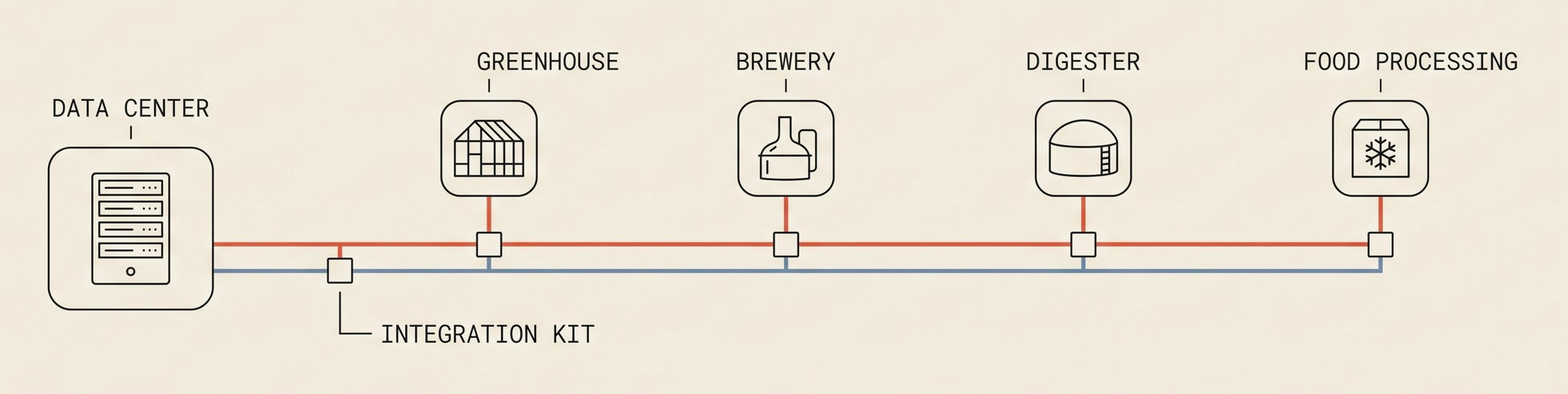
Schematic showing the data center supplying recovered heat through an integration kit to a greenhouse, a brewery, a digester and a food processing plant
Programmatic facility commits once, draws per site Per-site SPV bankruptcy-remote Land in fee Building 20 yr triple-net lease Amortizing senior bond tenor matched to lease · non-recourse to platform Security package • Land, building, lease • SPV equity pledge • Funded debt-service reserve • DSCR cash-trap on breach Generation SPV isolated from the rated facility debt power passed to tenant at cost

Capital structure and security package

Per-site vehicleBankruptcy-remote SPV

Each site sits in a bankruptcy-remote SPV that owns the land in fee on the owned sites, owns the building, and holds the 20-year triple-net lease as its principal asset.

DebtMatched, amortizing bond

The SPV issues fully amortizing senior secured notes with a tenor matched to the lease base term, retired entirely by contracted lease cash flow with no refinancing event, and non-recourse to the platform.

Security packageFirst liens and a cash-trap

First-priority liens on the land, the building, and the lease, plus a pledge of the SPV equity, a funded debt-service reserve, and a DSCR cash-trap that de-leverages on any breach.

Capital recoveryReturned at construction

A financial co-investor takes the project equity alongside the sponsor at 80 / 20, at project level and separate from this round. Equity is returned at construction when the bond takes out the build, collapsing the recycling cycle from a multi-year stabilization wait to a short construction bridge.

GenerationIsolated from the rated debt

On-site generation is financed in a separate vehicle, isolated from the rated facility debt, with power passed through to the tenant at cost.

Proven in the public market

This is not a novel structure. A recent 245 MW triple-net data centre bond priced at 6.19% rated BBB- by S&P and Fitch, with roughly $184M of prior equity returned at close, and its follow-on at 352 MW priced 20 basis points tighter at Baa2. Together they raised $7.5B of investment-grade, construction-stage capital against contracted leases. MicroLink's contribution is to industrialize that structure across a multi-site programme, and the company round funds the build that lets it start.

Eleven sites in New York, a $5.71 billion programme running behind it and a proven model of innovation and change. An investor entering at this round backs the company at the point where scaling starts. The full programme data room is available on request.